The Projector Man
- Language
- English
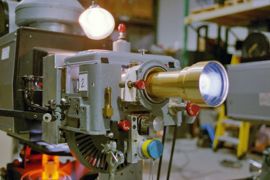
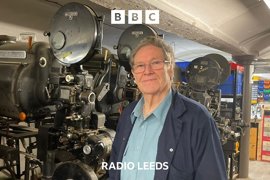
Jim Schultz is interviewed by Brian Megson about his life as a projectionist and cinema technician in this video shot at the Hyde Park Picture House.
Jim Schultz is interviewed by Brian Megson about his life as a projectionist and cinema technician in this video shot at the Hyde Park Picture House.
This is another fine mess you got me into. Thank you, good afternoon gentlemen, have a good evening. Thank you Andrew.
Thank you. Gets harder every time, doesn't it? Yeah, these steps don't get lower.
They don't, do they? Here we are, home sweet home. Magic lamp.
What are you going to do today then? Check the phone paths. Yeah.
And the connection on the lamp. And the connection on the lamp. Connection on the lamp.
Bulbs are okay. Yeah, well. Oh yeah.
My father was friendly with a cinema owner. And in the war, in 1942, his projectionist failed to turn up. Like artillery.
And my dad asked me if I'd ever go and I did. And that was my first time I saw a cinema projector. Thirty odd years old, it was as good as the day it was made.
And I liked the engineering, that's why I became involved. Yep, seems okay. Take a fork, yeah?
Yep. Getting warm, is that? Back in the war, I was with Ensor.
When the war ended, Ensor was finished. I went to BTH factory at Rugby, in the cinema repair depot. And from there I was called up.
Connection's okay. Want me to fire it up? Yes.
Okay. Did you do any projection when you were in the army? Yes, I did.
And projection repairs. 35mm? 16?
16mm. But when you came back then, you joined British Acoustic Films, was it? Yeah, Rank Caley.
Rank Caley, yeah. And then you started service in cinemas throughout the north of England, didn't you? Yeah.
And installing projectors. Installing projectors, yeah. That was just about the time when they were doing a lot of 12s, wasn't it?
Yes. Rank were putting a lot of 12s in all over the place, weren't they? And 21s.
And 21s, of course, yeah. What year did Kershaw's first start making projectors then, Jim? 1910, I understand.
1910?
Yeah, when they were influenced by men like George Groves' father, Albert. They adopted the name Caley as a corruption of Abraham Kershaw and the city of Leeds. Oh, this must be the Albert Groves' projector, is it?
This is the Groves' invincible projector. How old were that then, Jim? About 1911, 1912.
They made them up to the First World War. They were a copy of the Ernieman projector, weren't they?
Yeah.
They probably infringed patent rights as well. Good God. He died when he was 92, I believe.
Yes, he got knocked down, didn't he, outside his house or something? Took him three weeks to die. He was so tough.
I know when you went in his house, in his lounge, he had projectors stood in his lounge. All over the place. Do you remember the first cinema you ever serviced?
I would prefer to say breakdown, attended a breakdown. That was in Manchester, 1948. The government, Chorlton Comharty, had the phone in saying they had extraneous noises on the soundtrack with the film The Winslow Boy, a quiet picture with court scenes.
And it turned out to be the projectors thumping on the amplifier, drumming. What caused that then? The vibration did sign.
And when I checked it out, the amplifier still had the shipping bolts in. They said they'd never been taken out. So the thing then was on floats.
So the valves became microphonic then, with the projectors dumping on them. Good God. This is the Cayley No.
3. No. 3?
Yes, the first motion picture projector Kersh was made. And they copied it from the French Crono, a machine that was almost identical but painted green. This projector was influenced by the Lumière Cinematograph, the first projector that was successfully used in Europe.
The difference being mainly that the Lumière used round perforations, whereas the Edison design used rectangular perforations, which made all the difference. Can you remember the first time you did a service in Leeds? It wasn't the first I can remember.
It was the first time that I was rejected at the Plaza Cinema on Brigate. The old assembly rooms? Yes.
When I arrived, the chief projectionist wouldn't let me in the projection room. He said I was too young. And so I told him to phone my boss, who says to him, if he's good enough for me, he's good enough for you.
We later became firm friends. Wild, wasn't he then? Frank Wild, yes.
The shutter's conspicuous by its absence, this projector, because it's built inside the gate. It's the least efficient position, but it's mechanically sound. Normally they're in front.
And it's double-speeded to try and regain some efficiency. But they had to abandon it in the second machine, the Cayley 4. It came out with a front shutter.
When did we first meet, Jim? It must have been in the 40s. 1948.
1948. At the Scarlet Cinema. That's right, and you came up the steps with the oscilloscope, and everything's a box there.
I never dreamed in those days that we'd ever be going the miles, but we'd travelled all over the place. We'd been all over, hadn't we? And you'd been all over the world.
Not all over the world. Well, most of the world, anyway, let's put it that way. The framing was so bad.
The picture actually moved up and down, but only by the same distance as the lens moved. Do you remember the Scarlet Leeds when they took the sound out, the Western Electric sound out, and put Juvasonic in? Yes.
Do you remember the size of the bin that was there? It was a horrendous size. A loud-speaking telephone.
Yes, that's right, massively. What size would the woofers have been in those days? 15-inch.
Four 15-inch. And the tweeter, was that lead-loaded or something? Yes, that took two men to lift, because it was full of lead shot.
They later used cork. I remember the chief saying at the time, when they put the Juvasonic sound in, it was half the size of that. He said, we'll never get the same sound out of that.
It was absolutely beautiful.
Yes.
Absolutely beautiful. Why did the French use a 16-picture sprocket then, Jim? Well, they always favoured it from the original Lumière projector, I presume.
But the Americans favoured them as well. The British and the Germans never did. They preferred this big one.
But the big one on here is that size, because it's on the crankshaft, which had to turn at two revs per second, as the projectionist turned it. And being a big sprocket, it wouldn't move more film. And that would descend into the fire trap, which you notice is lockable.
Later ones, they were spring-loaded. You could not leave them open. And on the top fire trap, which is similar, there's always a gap.
You may ask the question, why is it so far away? And the idea was, if the film caught fire, the projectionist would be quick enough to rip it away. I mean, those universal bases that they had in the Odeon leads, they were there years longer than other places, weren't they?
Was that because the lease hadn't run out? And it was difficult to sell projectors to exhibitors in Yorkshire, because they used to say, you've got American machines in the Odeon. But it was a contract they couldn't get out of.
Was Ted there then? Ted Sturrus? But they had the Western Electric sound in.
That's right. Up to 1963. And I came one night and I put cinema-mechanical projectors in.
They're still there, number one theatre. They only ran these up until sometime in the First World War. And then, after the First World War, by right of conquest, they were allowed to take the German patents, and so they copied the German Ernemann projector.
Here's one of my old projectors, GLE-12, which I had in Eltsika. Yeah, that's pre-1938. The thing about these was, they didn't have a flicker shifter, did they?
They had a drum shutter. Especially that which worked quite well. One of the advantages, of course, you could just slide the plate out, and your different size frame, that's about cinema scope, that's widescreen.
And then, of course, you'd change the lenses, slot that back in again, turn the film up the way you went again, which with other machines was rather complicated, because you've got rollers at the top, remember? Yes. You had all them silly rollers to move, which made life a bit difficult.
The story I like about local projectionists around here was the guy in Sheffield, Ernest, at the Healy Coliseum, who insisted the picture should be round, not rectangular. The argument rose over cinema scope being wide. He said he would have favoured a round picture.
So I said to him, you could cut the aperture plates, and the gate could be opened, and taken off for cleaning. Very often there was a lot of swarf on it from some of the films. Like artillery.
This was the old Western electric soundhead, pull-through soundhead. The 3A, that was the first one after talking pictures. Well, you serviced this in your tap.
Oh, yeah.
You'd been up there and serviced it. Was he the chap that never had the monitor on the box? He wouldn't have sound in the projection room.
He said all the problems started when sound came in. This was in the late 50s. So he never turned the monitor on at all, just a silent picture in the projection room all the time.
When they supplied equipment to him, they actually had to supply a muting switch, so he couldn't hear the sound. Can I open it up? The thing I like to mention about the carbon arc is the end of the carbon had a temperature equal to the surface of the sun, and focused on inflammable film 32 inches away.
So if you wanted to adjust the mirror, you had to actually open the lamp-house door.
Put your hands in the back.
Very often there was an asbestos curtain on the back. Yes, I remember that, yeah. How many cinemas do you think there are left now that use carbons?
There can't be many. Only the future of Scarborough that I know of. And one in Clitheroe where one machine is carbons.
And they're the only ones I can think of around the area. They had the juice passed through the cable, which is coiled, which induced magnetism into this iron, which stabilised the flame. Like the bill of magnetism.
Because the flame on the carbon arc is electromagnetic. Of course, xenon lamps have made an awful lot of difference, haven't they, now, from carbons? They're too good to be true.
The light's constant all the time, isn't it? You don't have to have somebody stood by the side of the machine all night, do you? Feeding the carbon and making sure the light's OK.
That's made an awful difference. They're very good, but not as reliable as a carbon arc lamp was. A carbon arc lamp never lets you down.
Of course, the other thing, you could make sure there was plenty of oil in this because it used to shoot up there, didn't it? They're very, very good. Yes, you were always aware there was oil in the machine because you'd see it cascading down.
You used to replace those with pillboxes, if you remember. Oh, that's right. Yes, that's right, yeah.
Do you remember when we went down to that SO cinema? Where was that? Fawley.
In Fawley. What did they call it? The Riverside...
Riverside Cinema. Yes, the Riverside Cinema. And it's adjacent to the SO place.
It was owned by SO. Owned by SO, yeah. He hadn't a can of oil or anything, had he?
Nothing in the place to oil the projector. It hadn't been out for a year, had it? We sent him out to get some oil and he came back with a can of four-in-one oil, about a quarter of a pint of oil.
And the rewinder was held on the bench by a 12-inch screwdriver. Do you remember that? He brayed it in with a big hammer.
And it just disappeared, didn't it? And the mechanics and fitters, they all lived around the Hare Hills and East End Park area. So if you were walking around the area on a Sunday morning, you would often see them with their dogs.
First thing they'd say is, any projectors seized up this week? I remember going there to a demonstration of a KLE-21 and they had about 10 or 11 projectors on the bed running. And they told me they used to run those for 24 hours non-stop.
So that any faults that developed, they could sort it out straight away. Do you remember that? I remember a day after the war, in 1948, of five projectors seizing of one day, and specimens of the oil was taken, and it was found that it was the wrong sort of oil.
Manchester University analysed it, and all the oil was withdrawn. All new oil was issued to all the projectors. They never gave any more trouble.
Hence the reason you had to buy GB Kaley oil. The rank of organisation asked me to fit the projectors up Balmoral, and the projectors would be delivered by the Royal Household to the University, where I refurbished them. From there I saw them transmitted up to Balmoral, and I went up the next day and spent a week there fitting them.
From then on I serviced them every two years. In June or July, preceding the Queen's visit. The rank of organisation sent me this copy of the official order from the Home Office, to go to the Royal Yacht Britannia, which was at the time on its refit at the Portsmouth Dockyard, the Royal Dockyard.
It was the first time I'd ever worked on a ship. The projectors were installed in the gallery on a platform. On the back of the arc lamp there was a perspex panel.
People don't know what this was for. That was to stop the cooks messing with the knobs on the back of the arcs. This is a rare bird, there wasn't many of these, I remember them in the Majestic Lanes.
The unique feature of this of course is a penthouse sounder, it's a magnetic film. This was the flagship projector. This was in the finest theatres of the country.
Odeon Leeds never had them, surprisingly, but Majestic did. Well I would say originally that the Keighley projector was the best, except it stopped manufacturing spares in 1958. While the machine is still running here and there, you can't buy replacements.
So I must conceive that a contemporary machine, the Westar projector, must be the best, because they're still running and they're still making spare parts. It's as simple as that. That's a copy of this century projector, isn't it?
Yeah, an American machine. But made in England, nonetheless. This is the GK-21 projector.
Probably the most famous projector ever made in Great Britain, and greatly admired by the Germans. Very heavily over-engineered. How many of these projectors do you think are still running throughout Europe and the world?
Well I was told a few months ago there were still 5,000. There's many in Australia. I went to Nigeria for four days, and they kept me back ten days.
And the rank organisation phoned my wife and said, is Jim there? She said, no he isn't. I said, where is he?
She said, well if you don't know, nobody does. You sent him to Nigeria. She said, if you don't get him back before Christmas, I'll sue you.
The pedestal was so heavy, it took four men to lift it. We called that the Jumbo Foot, or the Queen Mary Foot. Whereabouts was that place in the Middle East that you went to?
Doha, Qatar. What was the story there? That was the place where there were no doors on the theatre, and it was two miles out of the city.
But when we left every evening, I would pack my tools, until one day the driver saw me and he said, don't pack your tools, leave them there. So I said, but there's no doors on the building. He says, no one will steal anything here.
There's a hand chopping the next day or something. He chopped Steve's hands off, evidently. Made my hair curl.
Some parts the Americans are making, like sprockets, aperture plates, and gearing, people have them locally made by engineers. In Belgium, part of the picture was on the roof as well as on the screen. It turned out the chromium plated the area around the picture gate, and it was reflecting through the lens, and presented another picture on the ceiling.
Just matte blacked it out with matte black paint. Was this Penthouse sounder that was magnetic, 4-track magnetic? That was for Fox.
What was the distance of the sound set there to the picture head? 26 frames. Same as from the optical?
Sound light behind, 26 frames. What did you think about the reproduction from these sound heads? It was good, but it was expensive, wasn't it?
Were they made by Kershaw's? Yes. British Acoustic Films.
Parts were made by Kershaw's. The thing was assembled down south. Do you remember Dickie Henderson?
He came to Leeds once, to the Grand Theatre, with one of the earliest radio microphones, and complained about its performance. The Westwick's company sent me, and the electrician met me, and showed me the microphone, and he said, you speak, and I did, and it was OK. Two or three other people, it was OK.
So he said, I'll fetch Mr. Henderson, who I didn't know Mr. Henderson was. Anyway, Mr. Henderson came, and I recognised him as the comedian. And he said, have you heard it?
I said, yes. He said, what do you think? I said, it was all right to me.
He said, well, listen to it on me, and he did. And it was terrible. And he said, it sounds as if there's something wrong with my chest.
What do you think? And I said, have you seen a doctor? And he looked at me coldly, and he says, I'm the bloody comedian here.
It was a fundamental mistake in the first place. They should never have had the sound ahead of the picture, because the oil from the projector used to filter down into the optics of the soundhead.
Oh, yes.
John Davis was the managing director of the company, and he came to see the opening, after the twinning of the Goldman Sheffield. And he asked for a reel of film to be run. And I said to the projector, run a reel.
And they did. And John Davis, who stood on the front of the balcony, says, have them change over. And they did, and lost sound.
And anyway, he said, stop. And then he said, why did they lose sound? Was it because of the micro switch in the shutter house on the projector?
I said, yes, it wasn't much of a factor. And he says, remove it, disconnect it, and put it on the front wall of the projector. Make them do it by hand.
And I thought, he's the managing director, and he knows all about the technical side. And my admiration for him grew immensely. Right, I've just finished this up, Jim.
Is it in good order? The sprocket hole's good? It's a badly pulled, I'm afraid.
It's not good at all. It's probably had some whack around about.
Yeah, look, pulled, you see?
It's runnable, no problem with it, but it's just been badly pulled. That goes on next, does it? Yes, yes, I'm going to thread it up now.
We'll just give it a running then, yeah. That's it. The day thou gavest, Lord, so to speak.
What do you think about this latest Dolby stereo then, Jim? Er, I like it. I'm not too fond of the new machines.
They're cheaply made compared with the stuff that, in my day, you know. But they work well. You don't think they'll stand up to the usage that our projectors in our time did, the Cayleys?
I shouldn't think so, no, but, I mean, they are running three or four shows a day at least. Right, stop it at this machine, Jim. Yep.
Stick it on this machine. It's a 2,000-foot spool going into a 5,000-foot spool box. Yep.
Which, as you say, is unusual. There's plenty of room with his hands then, you see. Right, Jim, you're going to run this lava lot.
Yep. Right, scope. Yep.
Have you changed the plate? Yes, I've changed the plate. And the lens.
And the lens, vacuum lens chain. Two sprocket holes back on that sound head. Yep.
Is the sound on? Well, the exciter lamp's on. Right.
It's customary to have the other projectionist, if there is one, check it now. And if there were three projectionists, three would check it. Three would check.
Are you going to check that, Jim, please? The projector had seized up, and it was met on the steps of a projectionist with a very short tie. And when he got up to the projection room, the thing that had seized it up was the other half of his tie.
And he'd evidently leaned over the machine, and his tie had waxed into the gears. Seized it up. I've got it now corrugated.
OK. Well, over the last 40-odd years, you've been a tremendous help to me. You know, I've run the cinema side of it, and you've made sure I've got a show on the screen.
Well, I used to say to some exhibitors, if it broke down on a Saturday night, I would go on a Sunday morning and say, where are you going to find an engineer, A, who's willing to come out, and B, who knows what to do, and C, has got the spurs to repair it? All set, Jim? Yep.
Can you take the lights down, please? One of the saddest things as well was the chief projectionist at the Shaftesbury Leeds, who dropped dead in the projection room during the children's matinee. Did you remember that, Jim?
He was formerly the chief at the news theatre in Leeds. Very nice chap. But they were showing a cartoon, and the cartoon finished, and after a while, the manager went upstairs because the screen had gone white, and he was laid there on the projection room floor, dead was the poor chap.
Had a heart attack. But they did have a boy drop dead in the Odeon projection room. Yeah, they did, didn't they?
During the show, when they were just about to change reels, and he fell on the floor, and the man changing the reels couldn't leave the machine to attend to him for a few seconds, you know. I've no regrets about being in the picture business. It was interesting because it included electrics, optics and mechanics.
If you hadn't been in the picture business, what would you have liked to have done? I don't know. I've often said to young people now, if you're in a job in service, wherever you go, people are always pleased to see you because you've come to help.
It's like the postman. Everyone was pleased to see the postman. I was working with a colleague, and he did something and the projector fell over, and the ventilator pipes from the arc lamp is full of a white deposit, which, when you disturb it, descends like snow, which is bad enough, except the projector falling over also knocked over a can of oil and flooded the projection room floor.
So there was this mixture on the floor, a terrible mess, and when we were going, we put it all back together again and were leaving. I shook hands with the projectionist, but he was truculent and miserable, morose, with my colleague, and when my colleague put his hand out, he refused to shake his hand. He told him to fuck off.
I hope I never see you again, he said. Too much envy, my colleague said afterwards. What was wrong with him?